
Authors: Jo, Kruger and Tennant
Journal ref: Jo, O., Kruger, E. and Tennant, M., 2021. Public transport access to NHS dental care in Great Britain. British dental journal, pp.1-9.
Background
Achieving equitable access to primary healthcare is a fundamental pillar of the National Health Service (NHS) and is influenced by a range of factors including cost, availability of appointments, and geographical location. Whilst geographic proximity to dental practices is a common metric for measuring access, physical distance alone does not guarantee availability. For individuals without private vehicles, public transport infrastructure dictates whether dental care is genuinely accessible, making transit poverty a critical but under-studied social determinant of oral health. Individuals who rely on public transport may experience delays in seeking dental treatment, have difficulty attending appointments, and face greater unmet oral health needs. This study explored how effectively public transport networks support access to dental services across Great Britain.
Aim
This study aimed to evaluate and map spatial accessibility to NHS dental practices across Great Britain, with a specific focus on public transport travel times for populations reliant on it, and to identify population groups at risk of transport-related barriers to oral healthcare.
Methods
The authors utilised advanced Geographic Information Systems (GIS) and travel time matrix software. They cross referenced the precise locations of 8,791 NHS dental practices in England, Scotland, and Wales with public transport timetables. Locations of rail, metro, light rail, bus and tram stops were mapped using GIS. Travel times were calculated from residential census areas during standard operating hours to identify regions where dental care was effectively unreachable within reasonable transit thresholds. Accessibility was assessed according to proximity to public transport stops and the availability of high frequency bus services.
Results
The spatial analysis revealed profound disparities in dental access, entirely driven by transport limitations. Most residents in Scotland (92%) and England (92%) lived close to a public transport stop, while this figure was slightly lower in Wales (84.2%). However, access to frequent and practical transport services was considerably lower. Significant proportions of the population, particularly in rural areas faced travel times exceeding an hour each way via public transport to reach their nearest NHS dentist. Conversely, urban areas showed dense coverage but frequently experienced a bottleneck in capacity issues. The data highlighted that socioeconomically deprived populations often lived in areas where public transport networks failed to align with healthcare infrastructure, compounding existing oral health inequalities.
Conclusion
Physical proximity to an NHS dental practice is a misleading metric if public transport links are inadequate. Many individuals, particularly rural residents and older adults, face significant barriers due to limited transport availability. These findings highlight that physical proximity to dental services does not necessarily equate to true accessibility. Healthcare commissioners must integrate transport infrastructure data when planning the distribution and funding of dental contracts. Addressing transport barriers is essential to reducing oral health inequalities and ensuring true universal access to NHS dental services.
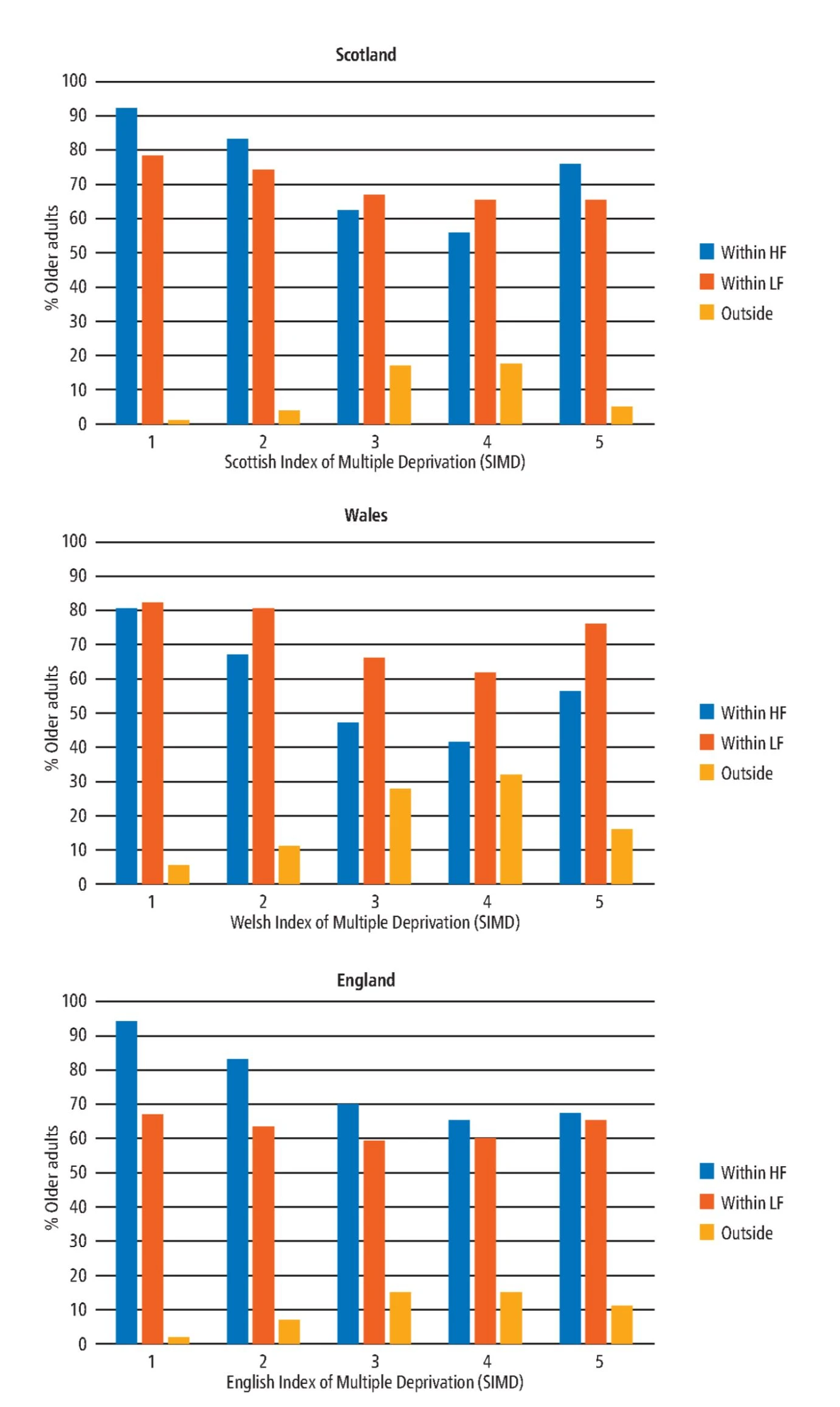
This figure shows the population of older adults across regions of Great Britain within high frequency bus stops, low frequency bus stops and outside all bus stops, categorised by deprivation indices.
Research Summary Written By: Shivani Das, Cardiff University – BDS 4