
Lin, E., Shroff, M.C., et al. (2022) ‘Differences in finished case quality between Invisalign and traditional fixed appliances’, The Angle Orthodontist, 92(2), pp. 173–179.
Background
Clear aligners, such as Invisalign, have become increasingly popular as an alternative to traditional fixed braces, mainly due to their aesthetic appeal and removability. However, questions remain about whether Invisalign can achieve comparable treatment outcomes to conventional fixed appliances. Objective assessment of treatment quality is therefore important to guide clinical decision-making and patient choice.
Aims
To compare the treatment and post-treatment effects of Invisalign aligners (incorporating SmartForce features) with traditional fixed appliances in patients with simple malocclusions.
Methodology
This randomized clinical trial included 66 patients: 32 treated with Invisalign aligners and 34 with traditional fixed braces. The median ages of the aligner and braces groups were 26.7 and 25.9 years, respectively. Pretreatment occlusion was assessed using the ABO Discrepancy Index (DI) which measures severity of malocclusion. Post-treatment and after 6-months of retention occlusions were quantified using the ABO Objective Grading System (OGS) which evaluates alignment, overjet, buccolingual inclinations, and overall occlusion.
Results
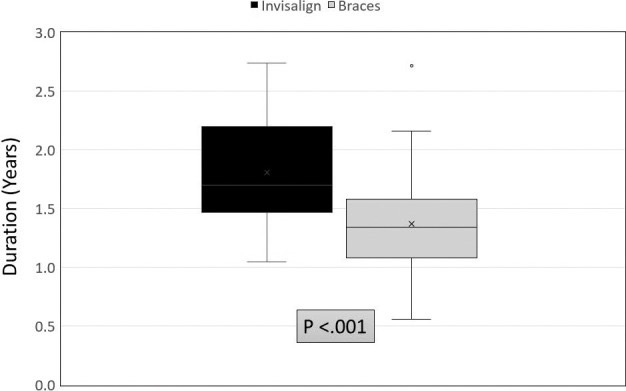
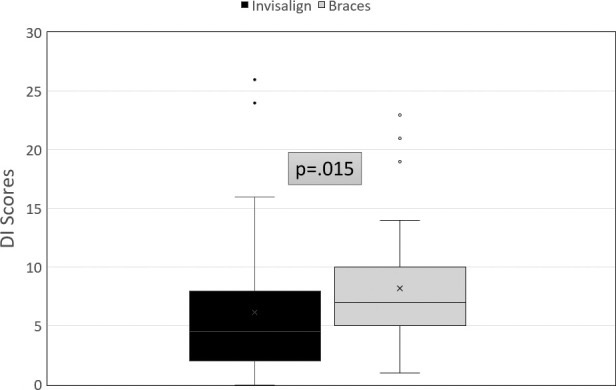
The group treated with traditional braces completed their treatment significantly earlier (P < 0.001) than the Invisalign group, by approximately 0.4 years (around 5 months). At pretreatment, the median DI scores were 4.5 for the aligner group and 7.0 for the braces group. Although this difference was statistically significant (P = 0.015), it was not considered clinically meaningful. At posttreatment and after six months of retention, there were no significant differences between the two groups in total OGS scores or any individual component scores. During the post-treatment period, alignment and overjet worsened significantly in the aligner group, while buccolingual inclinations and occlusal relationships improved. In the braces group, alignment also worsened and buccolingual inclinations improved. However, there was no statistically significant difference between groups in the overall change in total OGS scores during the post-treatment period.
Conclusion
This study demonstrates that Invisalign aligners can be a viable alternative to traditional fixed braces for patients with simple malocclusions. Although treatment duration was slightly longer with aligners, final occlusal quality and short-term stability were comparable between the two systems. These findings support patient choice based on aesthetic preference and comfort without compromising treatment outcomes. However, the relatively small sample size, single-centre design, inclusion of only simple malocclusions, and six-month follow-up period limit the generalisability of the results. Further research involving larger, more diverse populations and longer follow-up periods is required to assess long-term stability and effectiveness in more complex cases.
Figures
Box whisker plot of treatment duration.
Box whisker plot of discrepancy index (DI) scores.
Research Summary Written By: Manuel Vinod, University of Manchester – BDS 1