
Author Name/s: Marco Bergamini, Amerian D Sones , Van Ramos Jr , Nikita Murarka, Marwan M Fattouhi, Theodore E Jacobson
Journal Reference: Bergamini M, Sones AD,Ramos V, Murarka N, Fattouhi MM, Jacobson TE.Rotational path removable partial denture: The role ofdental implants in enhancing outcomes for complexclinical cases. J Prosthodont. 2026;1–5. https://doi.org/10.1111/jopr.70258
Background:
Removable partial dentures (RPDs) still remain a cost-effective option for restoring partially edentulous patients, particularly when fixed or implant-supported restorations are limited by anatomical and financial considerations. However, they can compromise aesthetics due to visible metal clasps, especially in the anterior region, which is overcome with Rotational path removable partial dentures (RPRPDs). Implant-assisted removable partial dentures (IARPDs) may further improve the support, stability and retention of these prostheses, particularly in patients with compromised posterior support .
Aims:
To describe the role of dental implants in conjunction with RPRPDs in a specific case report. Focus was emphasised on clinical guidelines and patient specific treatment planning considerations/anatomy.
Methodology:
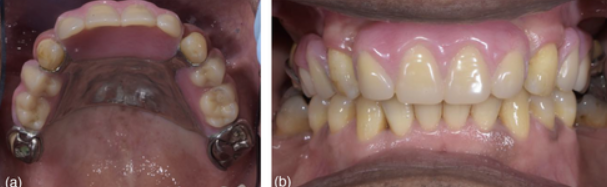
The paper presents a clinical case report involving a 64-year-old male patient with an edentulous anterior maxillary ridge, who was dissatisfied with the fit, comfort and aesthetics of his existing RPD. Clinical and radiographic examinations were performed to assess bone quality/quantity and the prognosis of the remaining abutment teeth. An implant-assisted RPRPD was selected following discussion of alternative treatment options. Treatment involved extracting a non-restorable maxillary premolar, placement of a posterior maxillary implant, fabrication of surveyed crowns and preparation of guiding planes and rest seats. The definitive RPRPD was then fabricated and delivered. Follow-up appointments assessed patient comfort, prosthesis function, tissue response and clinical performance.
Implant placement #3.
Preparation of guide planes
Metal framework try-in.
Results:
The patient reported extreme satisfaction with the aesthetics and function of the definitive prosthesis. The implant-assisted design allowed the distal extension to be converted into a more favourable tooth-implant-supported configuration (Kennedy Class III). The authors reported improved support, stability and load distribution, alongside reduced reliance on visible anterior clasps. Follow-up evaluations were conducted at one week, one month and subsequent recall intervals.
Discussion:
The paper explains that conventional distal extension RPDs can move during function because they rely on both the remaining teeth and the soft tissues for support. This movement can place extra stress on the abutment teeth and affect the stability of the denture. The addition of a posterior implant can help reduce this movement and distribute occlusal forces more evenly. Surveyed crowns and guiding planes also help control the path of insertion and improve the retention and stability of the RPRPD. This approach can also improve aesthetics by reducing the need for visible clasps. However, careful treatment planning is essential; including assessing the implant position, the condition of the remaining teeth and the patient’s occlusion. Good maintenance and patient compliance are also important for long-term success.
Conclusion:
The authors conclude that combining dental implants with RPRPDs may provide an effective treatment option for partially edentulous patients with compromised posterior support and high aesthetic demands. Strategic implant placement may improve support, stability, retention and load distribution while reducing visible clasps. However, further research is required to establish long-term clinical outcomes and refine treatment protocols.
Research summary written by: Malak Baho
University of Manchester, BDS 5